



Where did he go?
Simeon is oddly and obviously omitted from the blessings Moses proclaimed just before his death in Deuteronomy 33. Why is this? Well, let’s see if we can’t navigate this man’s life and try to uncover why his name is not even whispered in Moses’ final hour.
Simeon was the second son born to Jacob and Leah.
Now, Jacob’s heart rested with Rachel. She was the one of his affection. Her sister Leah, on the other hand, was the wife Jacob received through Laban’s deception. Leah knew the nature of her relationship with Jacob was anchored in this deception and she had a terrible time finding peace in her life.
When Simeon was born, Leah gave him that name:
Genesis 29:33 “Because YHVH has heard that I am unloved, He has given me this one also.”
Wow. A deeply troubling reality to be sure.
In Hebrew, his name is: שִׁמְעוֹן (Shim‘on). As you may be able to see, his name carries the root word: שָׁמַע (shema‘) = to hear, listen, obey. This is the same “shema” as in THE Shema, “Hear O’ Israel, YHVH is One” we find in Numbers 15 and Deuteronomy 6,11. A very powerful declaration that is held in great regard amongst the children of God even today.
This is a big deal.
Simeon begins with a prophetic identity. He is “the one connected to hearing”. There is no way to know for sure, but is it possible his line would have been tasked with speaking the Shema over the people for all of time? Maybe.
But as his life unfolds, there is a tension. Yes, he is named for hearing God, but sadly, he is ultimately known for not listening. And not just “lind of” not listening.
Genesis 34 tells the heartbreaking story of Jacob’s daughter Dinah being violated by the son of a local ruler. This son’s name was Shechem.
Shechem wanted Dinah as his wife. The sons of Jacob said there was no way she could marry someone that wasn’t circumcised so they made a deal, a covenant perhaps, with him. He could have Dinah and his people could have their daughters in marriage if they would agree to get circumcised.
They agreed. And then,
Genesis 34:25 On the third day after the circumcision, when they were in pain, two of Ya‘akov’s sons, Shim‘on and Levi, Dinah’s brothers, took their swords, boldly descended on the city and slaughtered all the males.
These hurt brothers did what they thought was noble and right. And maybe Shechem deserved to die.
BUT…
These two young men used the sign of the covenant with YHVH Himself to bring death upon these other men. Had they simply gone in and eliminated this man directly, maybe they would have been recorded as Biblical heroes. Men of righteousness, even.
Instead, they were brought low. Very low.
As Jacob was lying there on his death bed, he spoke blessings over his sons. Of Simeon and Levi, he said:
Genesis 49:5 “Shim‘on and Levi are brothers, related by weapons of violence. 6 Let me not enter their council, let my honor not be connected with their people; for in their anger they killed men, and at their whim they maimed cattle. 7 Cursed be their anger, for it has been fierce; their fury, for it has been cruel. I will divide them in Ya‘akov and scatter them in Isra’el.”
Their “blessing” was one of division, rooted in anger.
Fast-forward to the Exodus, and we see something remarkable take place. One event near the beginning of the 40 years, and another event towards the end.
As these two tribes navigate through the Wilderness, we see two very different paths appear for these brothers. And their decisions carried eternal consequence.
When the Children of Israel decided to fashion a golden calf for worship at the base of the mountain, it was the tribe of Levi that decided to stand on the side of righteousness with Moses. They had to lay sword to their fellow-tribesmen in order to stand on behalf of God. Not an easy decision but one they collectively agreed to choose.
Exodus 32:25 When Moshe saw that the people had gotten out of control — because Aharon had allowed them to get out of control, to the derision of their enemies — 26 Moshe stood at the entrance to the camp and shouted, “Whoever is for Adonai, come to me!” All the descendants of Levi rallied around him. 27 He told them, “Here is what Adonai, the God of Isra’el, says: ‘Each of you, put his sword on his side; and go up and down the camp, from gate to gate; and every man is to kill his own kinsman, his own friend and his own neighbor!” 28 The sons of Levi did what Moshe said, and that day three thousand of the people died.
In light of this bold decision, their path towards being scattered and ultimate fading into obscurity was abruptly interrupted.
29 Moshe said, “You have consecrated yourselves today to Adonai, because every one of you has been against his own son and against his own kinsman, in order to bring a blessing on yourselves today.”
Those men that had used the covenant to bring death to those men many years ago, are now tasked with overseeing, stewarding, and protecting the covenant until the Messiah arrived. They received no land as an inheritance but they got something far greater: Abba was their inheritance.
Wow! So if something like this could happen to Levi, it makes sense that the tribe of Simeon would take note and look for their own opportunity to be restored, right?
Well, no. In fact, the exact opposite happened.
Almost 40 years after the golden calf incident, another troublesome challenge came at the Children of Israel.
You probably recall the time Balak hired Balaam to curse Israel in the desert. Of course, that failed over and over, but Balaam told Balak what would work. Since they could not be cursed from without, the most sure way would be to curse them from within. If the women of Moab could entice the men of Israel into sexual immorality, then the curse would come upon them through their own actions instead of the words of man.
Sure enough, it worked.
A plague then descended over the people and 24,000 people died.
Who were these people?
In Numbers 1, a census was taken. This was at the beginning of the 40 years in the Wilderness. Then another census was taken at the end of the 40 years in Numbers 26. We’ll make a note that the incident at Ba’al Peor (the sexual immorality with the women of Moab) occurred in Numbers 25.
Here are the numbers from Numbers:
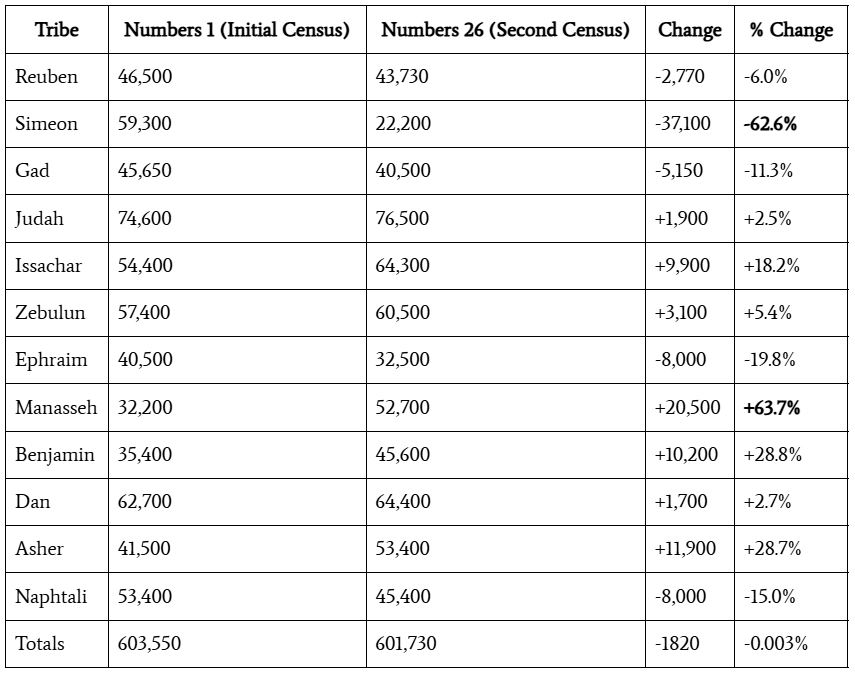
The overall numbers remained fairly constant over these 40 years. Some tribes grew tremendously (Manasseh, Benjamin, Asher) and some declined a fair amount (Gad, Naphtali, Ephraim), and one declined severely, Simeon.
Was there a reason for Simeon’s epic fall in number?
Maybe.
We all likely remember the story of Phineas. As the plague that killed 24,000 in the wake of Ba’al Peor was in full effect, a man of Israel and a woman from Midian came walking through the camp on their way to further sexual disaster.
Numbers 25:6 Just then, in the sight of Moshe and the whole community of Isra’el, as they were weeping at the entrance to the tent of meeting, a man from Isra’el came by, bringing to his family a woman from Midyan. 7 When Pinchas the son of El‘azar, the son of Aharon the cohen, saw it, he got up from the middle of the crowd, took a spear in his hand, 8 and pursued the man from Isra’el right into the inner part of the tent, where he thrust his spear through both of them — the man from Isra’el and the woman through her stomach. Thus was the plague among the people of Isra’el stopped; 9 nevertheless, 24,000 died in the plague.
In the same way the Levites stood with Moses at the golden calf, Phineas stood with YHVH. His sole action stopped what was set to consume many more lives. This is amazing to say the least.
But there is one more nugget of trivia built into the story. The man that came boldly through the camp while others were weeping over the tragedy around them had an interesting lineage:
Numbers 25:14 The name of the man from Isra’el who was killed, put to death with the woman from Midyan, was Zimri the son of Salu, leader of one of the clans from the tribe of Shim‘on.
As people were falling dead all around him, a leader of Simeon ignored it all to receive personal satisfaction.
Is this a coincidence?
After the incident at Ba’al Peor, a census was taken. Aside from Manasseh, most tribes of increase saw a fair incline. And even the ones that lost could easily be attributed to just the ups and downs of population variations.
But Simeon lost 37,100. This is nearly ⅔ the number they had 40 years earlier. And when we look back at the number lost at Ba’al Peor (24,000), it makes me wonder how many of those belonged to Simeon. If their leader had no regard for the well-being of their brethren, doesn’t it seem reasonable his followers would likely behave similarly?
I’m not saying Simeon accounted for the full 24,000 lives lost, but an argument could be made that a disproportionate number could in fact be from that tribe.
If you lived in a town with 60,000 people and within one generation you had less than 23,000, what would you attribute the loss to? Assuming no one just moved away for a better life someplace else, I think you would be as alarmed as I would be. Something out of the ordinary must have been the cause.
Fast-forward briefly and you see that Simeon does receive a small inheritance within the borders of Judah.
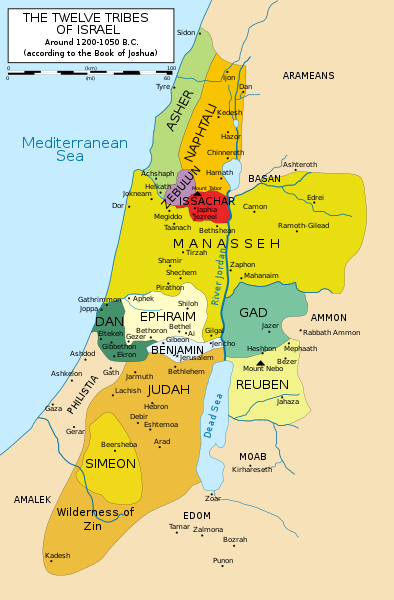
Notice that Simeon is the only tribe fully within the borders of one singular tribe. Every other tribe is adjacent to other tribes, not contained within.
As time marched on, we learn that Simeon was ultimately absorbed and the land was simply referred to as Judah, or the Southern Kingdom. Scattered among their brethren, the words of Jacob rung true:
Genesis 49:5 “I will divide them in Ya‘akov and scatter them in Isra’el.”
Simeon and Levi became forever linked the day they stood side by side in Shechem -- swords in hand, driven by anger, convinced they were doing what was right.
But that moment did not define their destiny. It revealed it. And more importantly, it set a trajectory.
Both brothers received the same words from their father:
“I will divide them in Ya‘akov and scatter them in Isra’el.”
The same judgment. The same starting point. But not the same ending.
Levi would one day stand again -- sword in hand -- but this time at the foot of the mountain. Not in vengeance. Not in reaction. But in alignment.
They chose YHVH over family. Truth over emotion. Obedience over instinct. And in doing so, their scattering was transformed into purpose. They were still divided but now they were distributed as carriers of the covenant.
Simeon, however, is never shown making that turn.
Instead, nearly 40 years later, we find a leader from his tribe, not resisting sin, but walking straight into it.
While others wept at the entrance of the tent, while judgment was already falling, a Simeonite leader moved forward as if nothing was happening.
Shechem was impulsive.
Baal Peor was willful.
And that difference matters.
What began as uncontrolled anger became unrestrained desire. What began as acting without God became living in defiance of Him. And what was once a moment became a pattern.
The numbers tell the rest of the story. A tribe of nearly 60,000 reduced to barely 22,000 within one generation. Not absorbed by migration. Not explained by natural fluctuation. Something happened. Something significant.
And then, silence.
When Moses stood at the edge of the Promised Land and spoke life over the tribes in Deuteronomy 33, every tribe is named. Every tribe is seen. Every tribe is blessed.
Except one. Simeon.
Not rebuked. Not corrected. Not restored. Just absent. And sometimes, that is the heaviest outcome of all. Not that God speaks against you but that your voice is no longer part of what He is saying.
Simeon was named: “God has heard.” But somewhere along the way, he stopped listening. And that is the tension that echoes far beyond his life.
Because the call over Israel was never just “Be heard.” It was: “Hear, O Israel…”
Simeon stands as a quiet warning written into the fabric of Scripture:
You can be seen by God. You can be known by God. You can be part of His people. And still fail to hear Him. And when hearing stops, drift begins. When drift continues, patterns form. And when patterns go uncorrected, inheritance fades.
Levi shows us what happens when correction is received.
Simeon shows us what happens when it is not.
Two brothers.
Same beginning.
Same prophecy.
Two very different endings.
Hear, O Israel!
Because what you do with what you hear may determine whether your name is spoken…
or quietly disappears.