



Genesis 2:8 Adonai, God, planted a garden toward the east, in ‘Eden, and there he put the person whom he had formed. 9 Out of the ground Adonai, God, caused to grow every tree pleasing in appearance and good for food, including the tree of life in the middle of the garden and the tree of the knowledge of good and evil.
10 A river went out of ‘Eden to water the garden, and from there it divided into four streams. 11 The name of the first is Pishon; it winds throughout the land of Havilah, where there is gold. 12 The gold of that land is good; aromatic resin and onyx stone are also found there. 13 The name of the second river is Gichon; it winds throughout the land of Kush. 14 The name of the third river is Tigris; it is the one that flows toward the east of Ashur. The fourth river is the Euphrates.
Here in the second chapter of Genesis, we are given what seems to be some bonus geographical information. We read about creation in chapter 1 that culminates with Abba ceasing His work at the beginning of chapter 2. A mention of the Tree of Life and the Tree of the Knowledge of Good and Evil, as well as these streams, then we jump into the creation of Eve, the fall, the murder, and so on.
Every time I read through this, I can’t help but stumble around its meaning. Obviously the trees are important as we learn in chapter 3, but the river and these streams come across as an oddly placed interjection. Why mention them here and in fact, why any mention at all?
Well, one thing I have learned for certain is that there is not one wasted word in all of God’s Word. Let’s see if we can somehow get context on why this is here and what it is telling us.
Before we go much further, let’s understand the meanings of the names of these streams:
Meaning: to spread, to disperse, to increase
Root: פוש (to spread): to scatter, overflow, grow abundantly
This actual word, Pishon, is only used once but its root shows up a few times throughout the Tanakh. Conceptually it is tied to increase and expansion outward. So Pishon represents expansion and multiplication, life that doesn’t stay contained. It flows around Havilah, a land associated with gold, bdellium, and onyx -- resources, richness, provision.
The theme is that God’s life produces increase and abundance.
Why would Adam and Eve need gold, aromatic resin and onyx stones?
These were not survival resources. They were elements of glory, worship, and identity. Eden already contained the materials later used in God’s dwelling. From the beginning, God’s presence was meant to dwell with man.
Meaning: to burst forth, to gush, to spring up
Root: גִּיחַ (giyach): to gush out, erupt, bring forth
Gihon represents the sudden, powerful emergence of life, something that cannot be contained. It flows around Cush, often associated with distant or outer regions.
The theme is that Life from God breaks out -- unstoppable, generative, birth-like.
Meaning: Commonly understood as swift, sharp, or rapid
Possible Root: חד (chad) - sharp / חדל (chadal): to move quickly or pierce
Often identified as the Tigris River, Hiddekel represents focused, directed movement, not just spreading, but purposeful flow.
The theme is that God’s life moves with intention and precision.
Meaning: fruitful, to break forth, to increase
Root: פרה (parah): to be fruitful, multiply
Often identified as the Euphrates River, Perath represents mature fruitfulness, the end result of divine life.
The theme is that God’s life produces lasting, visible fruit.
---
When you step back, the four rivers aren’t random, they form a progression of divine life:
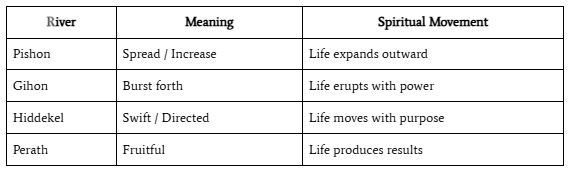
Now these are simply the 4 expressions of one thing at the head of it all.
Genesis 2:10 says: “A river went out of Eden to water the garden…”
There is one source which has four expressions. And this pattern shows up throughout Scripture. Here in Genesis, life flows outward from God’s presence, and in Ezekiel 47 we see a river flowing from the temple bringing healing. Yeshua even said in John 7:38 that “rivers of living water will flow from within”. Together these describe a complete cycle of divine life:
Source → Expansion → Emergence → Direction → Fruitfulness
This is not just the pattern of rivers, it is the pattern of life with God. The rivers show what happens when life flows from Abba:
It cannot be contained, it spreads (Gihon).
It spreads beyond boundaries, it cannot be contained (Pishon).
It moves with purpose, swiftly (Hiddekel).
It produces fruit (Perath).
Sounds like the life we’re supposed to live, huh? It most certainly is the life Yeshua lived.
This pattern of one source expressed in four ways does not stop in Genesis. It appears again in how Messiah is revealed to the world. Each Gospel presents Yeshua from a distinct angle:
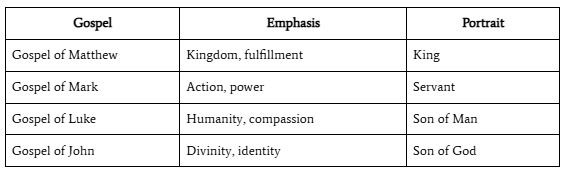
Four Gospels, four rivers. Any other “fours”? Actually, yes. There are the four winds (His Spirit) and the four corners of the earth (totality on earth). There are also the 4 faces on the living creatures in Ezekiel 1 and Revelation 4.
Ezekiel 1:10 as for the appearance of their faces, they had human faces [in front], each of the four had a lion’s face on the right, each of the four had a bull’s face on the left, and each of the four had an eagle’s face [toward the rear] — 11 thus their faces.
Revelation 4:6 In front of the throne was what looked like a sea of glass, clear as crystal. In the center, around the throne, were four living beings covered with eyes in front and behind. 7 The first living being was like a lion, the second living being was like an ox, the third living being had a face that looked human, and the fourth living being was like a flying eagle.
Notice how these align with the Gospels: Lion-King, Ox-Servant, Man-Man, Eagle-God.
These four faces are upon the four living creatures that are in the presence of God. Four expressions, all originating from the same source.
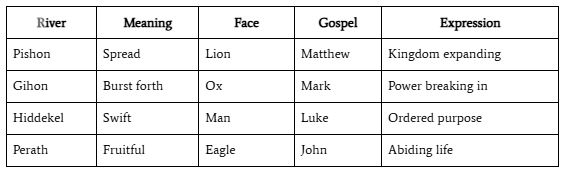
According to Jewish tradition, the twelve tribes of Israel camped and marched under four primary standards (banners), each associated with a specific emblem, color, and tribal group. These banners typically bore the emblems of a lion (Judah), a man (Reuben), an ox (Ephraim), and an eagle (Dan), with the colors corresponding to the stones on the High Priest's breastplate.
According to Numbers 2, we see that Judah camped to the east, Reuben to the south, Ephraim to the west, and Dan to the north.
It appears the camp and Tabernacle arrangement reflect these same four faces, the very faces of the four living creatures.
From this very place, we have four rivers that are God’s life flowing to the whole earth. Through the tribes, life flows. Similarly, the four Gospels are God’s full testimony of the Messiah to the whole world. What began in Eden as one river flowing into four directions becomes in Yeshua one truth in four witnesses.
Abba’s pattern is consistent:
And this doesn’t stop here in some metaphorical idea. It actually flows from within us:
John 7:38 “Whoever trusts in me… rivers of living water will flow from within him.”
Pulling this all together:
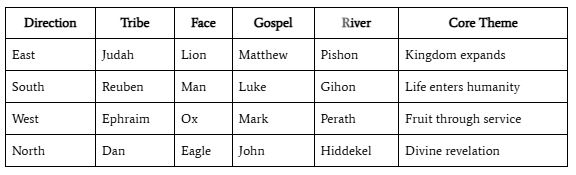
The pattern we now see is this:
At the Center
Flowing Outward
The result is that life reaches the entire world…through you!
You receive from the center (God’s presence).
That life spreads (Pishon).
It bursts forth (Gihon).
It moves with purpose (Hiddekel).
It produces fruit (Perath).
And the good news is that our Source never runs dry.
Psalm 46:4 There is a river whose streams make glad the city of God, the holy place where the Most High dwells.
Jerusalem had no natural river, meaning the “river of God” is His presence Himself.
Psalm 65:9 You visit the earth and water it; You greatly enrich it; the river of God is full of water…
What began in Eden did not end in Eden. The river was never meant to stay contained within a garden. It was always moving somewhere, always pointing forward.
The prophets saw it.
In Ezekiel 47, Ezekiel is brought to the threshold of the Temple. What starts as a trickle becomes a stream, then a river, then something so vast it cannot be crossed. It flows east, the very direction mankind was driven when leaving Eden, and everywhere it goes, life returns.
Dead places live. Barren land becomes fruitful. Even the waters of death are healed.
This is not just a river. This is the undoing of the fall.
And then the vision expands.
In Zechariah 14, we are told that living waters will flow out from Jerusalem, not just in one direction, but both east and west. In summer and in winter, without interruption. This river does not depend on seasons. It does not dry up. It does not stop. It is the constant outflow of God’s presence into the earth.
Then Yeshua stands and makes a declaration that changes everything:
John 7:38 “Whoever trusts in me… rivers of living water will flow from within him.”
He does not point to Eden. He does not point to the Temple. He points to Himself. And then, astonishingly, He points to us.
The river is no longer just something to observe. It is something to receive. And then something to become.
Yeshua is the source, but through Him, the river now flows through those who trust in Him. What Ezekiel saw coming from the Temple, Yeshua now places inside the believer.
Finally, we arrive at the end of the story, which looks remarkably like the beginning.
Revelation 22:1 “Then he showed me the river of the water of life, bright as crystal, flowing from the throne of God and of the Lamb…”
The river is back where it began, flowing from the presence of God.
But now it is greater.
What was once a garden is now a restored creation. What was once four rivers is now one eternal, unstoppable flow.
This is where your story meets the river.
You are not standing outside of it. You are not meant to simply study it. You are meant to live in it. And more than that, you are meant to carry it.
The river that flowed from Eden…
The river Ezekiel saw…
The river Zechariah proclaimed…
The river John witnessed…
is meant to flow through you.
The question is not whether the river is flowing. It is.
The question is whether we are connected to the Source, aligned with its flow, and have surrendered to its movement. Because when we are, something happens:
Dead things come back to life.
Dry places begin to flourish.
And the presence of God moves beyond us into everything we touch.